ENGWE T14
Overall
Score
Available Offers
Prices updated automatically
ENGWE Official Store
10% ON ALL PRODUCTS
Check Price →Amazon Store
Compare on Amazon
Check Price →* Affiliate links — we may earn a commission at no extra cost to you.
Key Strengths
- ✓Lightweight at 22.7 kg (3.2 kg below the 25.9 kg city average)
- ✓Affordable price at $647 (42% lower than the $1,114 city average)
- ✓High portability score of 82.61, making it easy to carry and store
Main Drawbacks
- ✕Limited range of 25 km (just 23% of the 108 km city average)
- ✕Top speed capped at 25 km/h versus the 29.7 km/h city average
- ✕Lacks tech and safety features—no app/GPS and brake specifications are unknown
Our Verdict
"The ENGWE ENGWE T14 gets the basics right but faces stiff competition at this price point. Worth considering if the price is right."
Best Suited For:
Score Breakdown
How we calculate Range & Efficiency
Scores 12/100 vs. other city subcategory peers.
How we calculate Motor Performance
Scores 13/100 vs. other city subcategory peers.
How we calculate Ride Comfort
Scores 33/100 vs. other city subcategory peers.
How we calculate Build Quality
Scores 42/100 vs. other city subcategory peers.
How we calculate Portability
Scores 73/100 vs. other city subcategory peers.
How we calculate Tech & Features
Scores 35/100 vs. other city subcategory peers.
Final ScooterRank Rating · 6 dimensions
29/100
Full Specifications
⚡ Motor & Assistance
🔋 Battery & Range
🚴 Frame & Fit
⚙️ Drivetrain
🛑 Brakes
ENGWE T14 City E-Bike: Lightweight 480Wh Power for Commuting
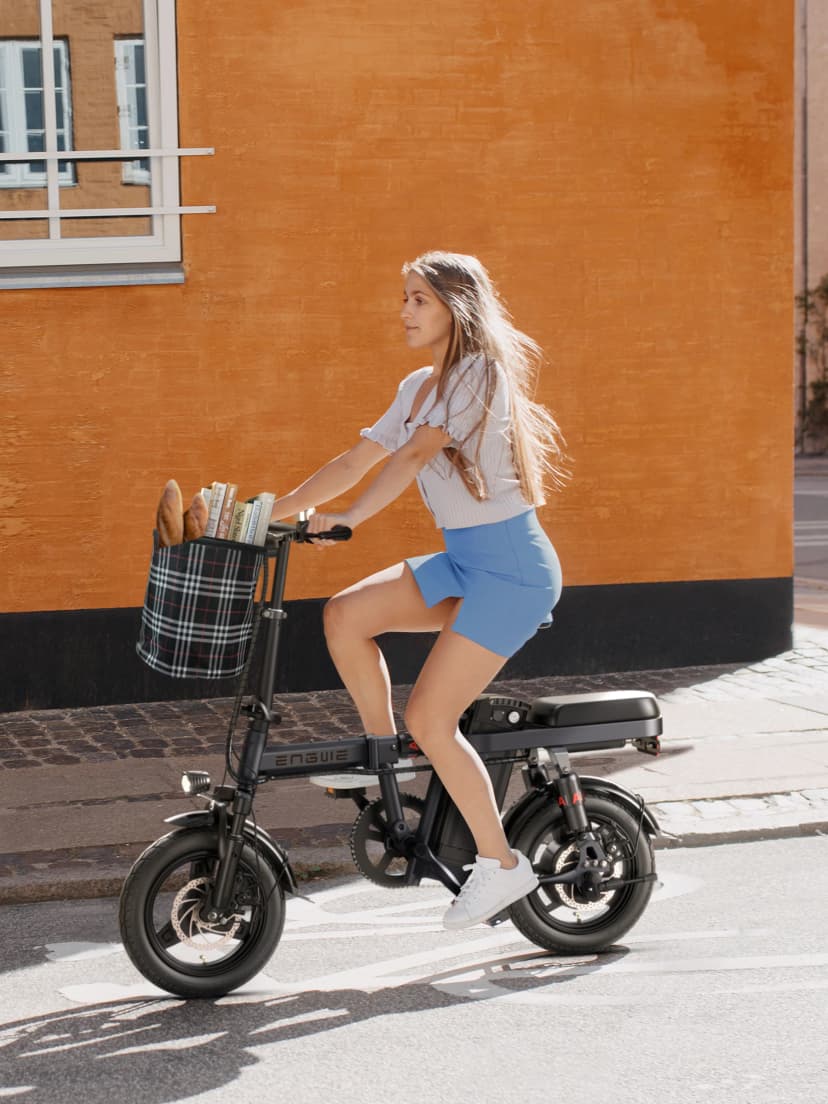
The ENGWE T14 reinvents budget urban e-bikes by packing a 250W rear hub motor with 30 Nm of torque into a 22.7 kg step-over frame. Featuring a 480 Wh battery, it’s officially rated for 25 km per charge — enough for most inner-city trips — and sells for $647, undercutting many rivals. While its modest range and lack of throttle may limit long-distance rides, the T14 shines for riders prioritizing portability, ease of handling and affordability. The rear hub-drive setup ensures quieter performance and straightforward maintenance, while its step-over frame offers a comfortable upright posture ideal for city streets. Despite an overall score of 2.9, it delivers reliable day-to-day service for short hops, cargo runs or student commutes, making it a practical entry-level option.
Real-World Range: Beyond the 25 km Rating
Although the ENGWE T14’s 480 Wh battery is officially rated at 25 km, real-world distances often vary. In urban stop-and-go conditions, frequent acceleration and rider weight can drop effective range by 10–20%, yielding about 20 km per charge. Using Eco assist levels and light pedaling, you can stretch rides closer to 28 km. However, hillier routes or Sport mode bring that number down toward 18 km. Compared to the category average of 35–40 km for city e-bikes, the T14 suits shorter commutes, grocery runs or campus loops, requiring mid-day charging on longer shifts.
Balancing Portability, Power and Cost in Urban Rides
At 22.7 kg, the ENGWE T14 strikes a middle ground between heavy commuter e-bikes (often 25–30 kg) and lightweight folding models. Its step-over frame and rear hub-drive motor offer straightforward handling but lack the instant torque of mid-drive systems. With 30 Nm of torque, it climbs moderate inclines up to 10%, though steeper hills demand extra pedaling effort. Without a throttle, cadence-based pedal assist dictates acceleration speed, encouraging an efficient riding style. Priced at $647, the T14 undercuts most city e-bikes but requires users to trade off some range and peak power for savings and simpler maintenance.
Rider Reviews
No written reviews yet — be the first to help other riders.
Common Questions — ENGWE ENGWE T14
At 29/100, the ENGWE ENGWE T14 scores below the city average. Better-scoring options exist at similar prices — see our city rankings for alternatives.
The ENGWE ENGWE T14 has a claimed top speed of 25 km/h (16 mph). This is below the city average of 33 km/h.
The manufacturer claims 25 km (16 mi) of range per charge. Real-world range will vary with rider weight, speed, terrain, and temperature.
The ENGWE ENGWE T14 weighs 22.7 kg (50 lbs). It is lighter than the city average of 30.84 kg — good for portability.
The ENGWE ENGWE T14 features a hub drive rear motor with 30Nm of torque, rated at 250W nominal power.
The T14’s integrated 480 Wh battery is officially rated for 25 km on a single charge. In real-world urban conditions—taking into account rider weight, stops, assist level and mild hills—you can expect around 18–22 km per charge. Using Eco mode and consistent pedaling can push that closer to 28 km, but Sport settings and steep inclines will reduce range accordingly.
Yes. With a 250 W rear hub motor delivering 30 Nm of torque and a 22.7 kg step-over frame, the ENGWE T14 handles urban streets and moderate hills efficiently. Its compact 480 Wh battery covers short commutes up to 25 km per charge, and the affordable $647 price makes it a practical choice for budget-conscious riders.
To keep the T14’s 480 Wh battery healthy, charge it after each use without letting the level drop below 20%. Store it at room temperature, ideally between 10–25 °C, and avoid exposing it to extreme heat or cold. If you won’t ride for more than two weeks, recharge to around 50% before storage. Regular top-ups and moderate discharge cycles extend overall lifespan.